Rechercher...
Corsican cultural traditions during the Christmas period: polyphonic singing, bonfires, midnight mass and live nativity scenes. New
 L’atmosphère singulière d’un Noël en Corse © Sylvain Alessandri / ATC
The Christmas bonfire: ‘Ô Rocchiu!’
The Christmas bonfire, known as Rocchiu, is one of the island's most iconic traditions, inherited from ancient rituals linked to the winter solstice. In front of the church, a large communal fire made of logs and branches symbolises light and protection for the whole community, extending the warmth of the Nativity beyond the walls of the sanctuary.
In the villages, 24 December belongs to the children, who go from house to house and garden to garden shouting ‘Ô Rocchiu!’ to collect wood.
The inhabitants willingly offer a log or an old piece of fence, and in the square, the pile of wood gradually becomes a kind of burning hut at the end of Mass.
The fire burns all night, watched over by the villagers, and in the morning, everyone comes to collect some ashes to mix with those from their own hearths, in order to protect their homes, ward off misfortune and ensure prosperity and health for their families.
Christmas Masses in Bastia, Ajaccio, Corte...
 Midnight Mass: lights, bells and Corsican fervour @adobestock
In towns and cities, the solemnity of Christmas is expressed above all through the grand masses celebrated in cathedrals and churches.
- In Bastia, Sainte-Marie Cathedral, the spiritual heart of the city, fills with worshippers who have come to attend midnight mass, surrounded by the garlands and decorations that illuminate the Old Port and the citadel.
- In Aiacciu (Ajaccio), the cathedral is adorned with lights, while the bell towers punctuate the evening with repeated calls to celebration.
- In Corti (Corte), the parish church becomes a gathering place for local residents, who sometimes make a special trip from the villages to share in this celebration in the heart of the Corsican mountains.
Midnight Mass is characterised by a particularly careful liturgy, alternating between readings, homilies and hymns sung by the congregation.
Traditional Latin and Corsican songs rub shoulders with French hymns, and many parishes favour simple tunes sung in chorus, encouraging the participation of entire families.
The brotherhoods, which are a true tradition in Corsica, contribute to the popular fervour during the festivities.
At the end of the service, the bell towers stand out in the night, often illuminated by garlands or festive decorations that highlight the silhouette of the villages clinging to the mountains or the coastal towns.
Live nativity scenes and children in costume
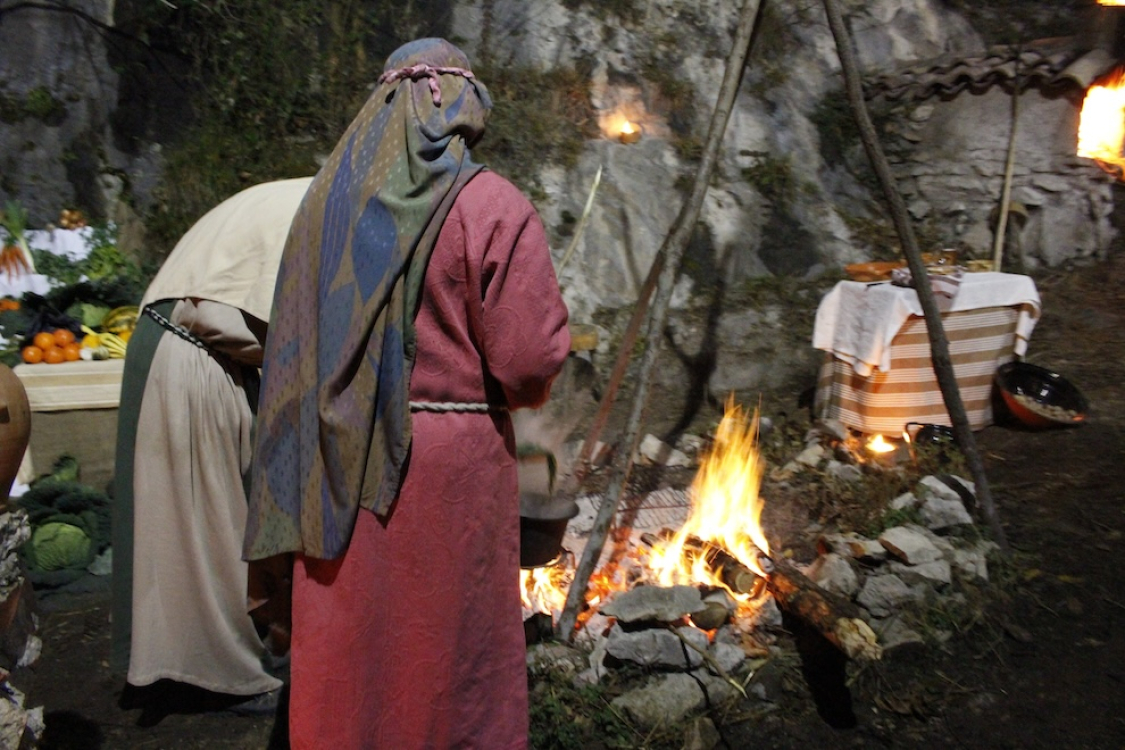 Live nativity scenes bring the Nativity to life @adobestock
Alongside liturgical and family celebrations, many parishes organise live nativity scenes that bring the story of the Nativity to life.
In the square or in the church, a stable is recreated with a few animals and a child lying in a manger to represent the Baby Jesus.
The village children often play the leading roles, dressed as shepherds, angels, wise men or inhabitants of Judea, which involves them directly in the festivities. Parents and grandparents watch the scene with emotion, seeing these living tableaux as a way of passing on their faith and traditions.
These living nativity scenes are sometimes accompanied by short readings and prayers, forming a kind of open-air catechism or church service. Everyone, from the youngest to the oldest, finds a place in the great shared story of the birth of Christ.
Christmas with the family: Christmas Eve, dinner and light displays
 La veghja di Natale (Christmas Eve), a tradition that gives pride of place to the elderly @adobestock
After Mass, Christmas Eve continues with the family gathered around a large table, which becomes the true heart of the celebration. The dishes are simple but rich in meaning: charcuterie, figatellu grilled in the fireplace, pulenta, cheeses and sweets such as frappes accompany the conversations.
The veghja di Natale (Christmas Eve) is not just about the meal, it is also a time for passing on traditions, where the elders take centre stage.
Around the fire, stories from the past are shared, the deceased are remembered, and the older members of the family recite prayers learned in their childhood, which the children listen to with curiosity.
The children play, running from room to room, while the adults stay up late talking about the past year and the year to come.
In this atmosphere, the flame in the fireplace, symbolic heir to the Rocchiu lit in the square, recalls the light of the Nativity that watches over the house until morning.
From 28 December to New Year's Day: Holy Family, Holy Innocents and New Year's greetings
The Christmas period in Corsica does not end on 25 December. It continues until New Year's Day. The following Sunday is often dedicated to the Feast of the Holy Family, which honours Jesus, Mary and Joseph.
On 28 December, the Feast of the Holy Innocents commemorates the massacre ordered by Herod and gives the end of the year a tone of compassion and prayer for the most vulnerable.
- As 31 December approaches, families prepare for New Year's Eve, which combines festive joy with blessings for the coming year. At midnight, greetings are exchanged in the traditional form of ‘Pace è Salute’, wishing everyone peace and health.
Christmas in Corsica is distinguished by a unique blend of ancestral rituals, vibrant Catholic liturgy and musical and theatrical heritage, where the Rocchiu fire echoes the voices of polyphonic singing and the silhouettes of children dressed in costume in live nativity scenes. For the curious traveller, experiencing Christmas in a Corsican village or town, at the foot of a bonfire, in an illuminated cathedral or in front of a lively nativity scene, is to enter the heart of an island culture.
It makes the Nativity a time of remembrance, sharing and ‘Pace è Salute’ for the year ahead.
Locate