Rechercher...
The island's hidden treasures: discovering Corsican grape varieties
¹ https://www.vinsdecorse.com/fr/tendances-chiffres-marches
An exceptional wine-growing heritage
The Phoceans introduced vines to Corsica 26 centuries ago. Since then, the Romans, Tuscans and Genoese have enriched this unique heritage. Corsica's vineyards are small but precious (1% of French vineyards⁴), offering an astonishing diversity of terroirs: granite soils in the south, schist in the north-east and limestone in between.
The island has 133 private wineries and 4 cooperatives that produce 357,600 hl of wine per year⁵. Production is divided into 67% rosé, 17% red and 16% white, spread across nine protected designations of origin (PDOs) and one protected geographical indication (PGI) ‘Île de Beauté’.
The three noble grape varieties of Corsica
Three iconic grape varieties account for 73% of the island's vineyards⁶.
Niellucciu, king of Patrimoniu (Patrimonio) and cousin of Sangiovese, covers 1,552 hectares⁷. Its red wines, with their beautiful deep colour, are bursting with aromas of blackcurrant, blackberry and woody notes. Tannic and full-bodied, they improve with age. As a rosé, it produces lively wines with notes of red fruit and cinnamon.
Sciaccarellu, the star of Aiacciu (Ajaccio) with 961 hectares⁸, is Corsica's signature aroma. It offers a unique bouquet of pepper, blackcurrant, cherry, liquorice and raspberry. Its cherry-red to ruby-red wines have a light structure and a smooth palate. As a rosé, its finesse expresses notes of red fruit and flowers.
Vermentinu, the star of the whites with 854 hectares, produces pale yellow wines with green highlights. Its complex nose combines hawthorn, pear, citrus and almond. These balanced wines offer fullness and length on the palate, sometimes with a beautiful minerality.
² https://www.vinsdecorse.com/fr/naturellement-singulier/cepages
³ https://www.vinsdecorse.com/uploads/e7b8aaf30fb5677126750278c4de4dba.pdf
⁴https://www.vinsdecorse.com/fr/tendances-chiffres-marches
⁵https://www.vinsdecorse.com/fr/tendances-chiffres-marches
⁷ https://www.vinsdecorse.com/uploads/25ea5487d38c971fca15c96cbd14617a.pdf
⁸https://www.vinsdecorse.com/uploads/29d321a1f67f24a586d27415c551b571.pdf
⁹https://www.vinsdecorse.com/uploads/c01ab07b40edaf5da94f253044bb1c68.pdf
Endemic grape varieties experiencing a renaissance
Several lesser-known gems enrich Corsica's wine heritage.
Biancu Gentile, native to the south, produces pale yellow wines with aromas of grapefruit, exotic fruits and honey. These wines are full-bodied, long-lasting and refreshingly crisp.
Genovese, once grown in Haute-Corse, produces wines with a subtle nose reminiscent of white flowers and citrus fruits. The palate reveals tension, richness and concentration.
Aleatico produces dark red wines with exuberant aromas of muscat, rose and lychee. Its good acidity also makes it ideal for sweet wines.
Minustellu produces very colourful wines with aromas of blackberries, blueberries and spicy notes. Its tannins are present but remain supple and silky.
Carcaghjolu Neru produces garnet-coloured red wines with aromas of blackcurrant and bay leaf. As a rosé, it expresses notes of light caramel.
There are also rarer grape varieties, such as Muscateddu, with its original aromatic profile (muscat, rose, pomelo), and Muriscu, with its aubergine-coloured berries. These are being studied at the Wine Research Centre (CRV).
I).
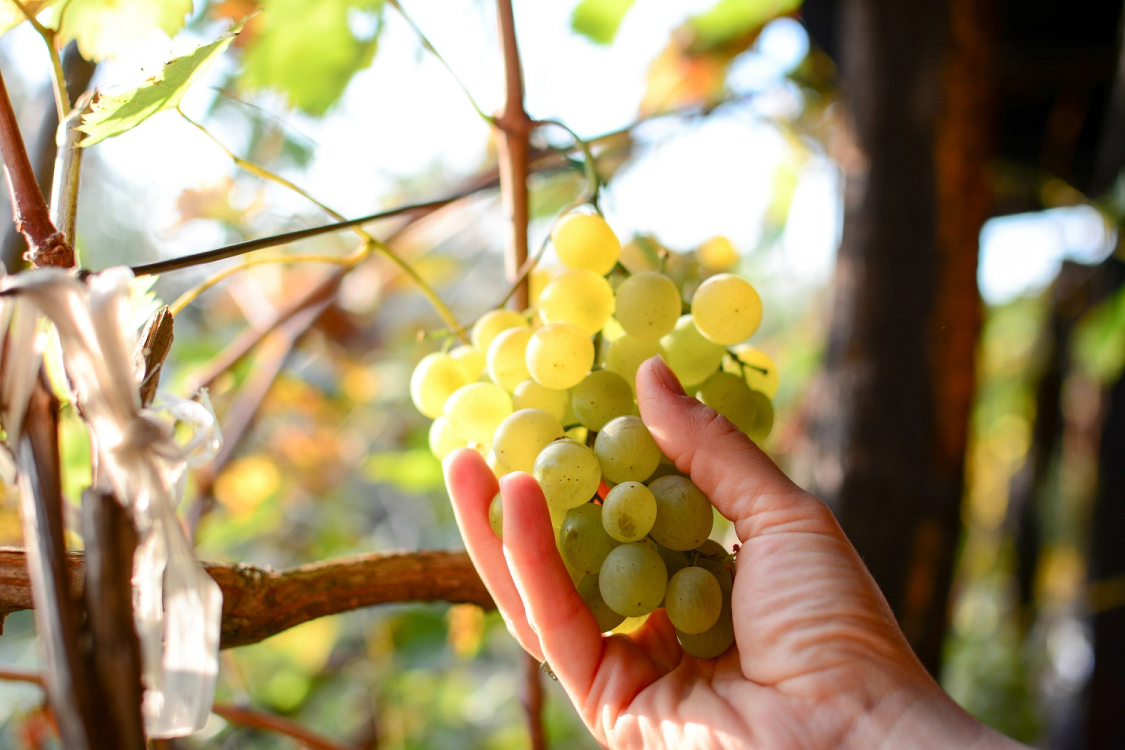 Among Corsica's wine gems, Muscateddu is one of a kind ©adobestock
Corsican appellations, exceptional terroirs
Each of Corsica's nine PDOs reveals a different facet of the island¹⁰.
The Patrimonio PDO (406 hectares, 14,064 hl), the first recognised appellation, produces powerful reds, subtle whites and crisp rosés. The vineyard is almost entirely organic.
The Ajaccio AOP (114 hectares, 3,708 hl), the birthplace of Sciaccarellu (minimum 60% in the blend), offers wines with a strong character.
AOP Corse Calvi (120 hectares, 3,523 hl) produces light rosés, aromatic whites and full-bodied reds. All its estates are organic.
The Muscat du Cap Corse AOP (22 hectares, 308 hl) offers naturally sweet wines with aromas of candied fruit and citrus.
The other appellations (Porto-Vecchio, Figari, Sartène, Corse and Coteaux du Cap Corse) complete this mosaic of terroirs.
Good to know:
the Riaquistu Corsican wine industry Le Riacquistu (reappropriation in Corsican) refers to the cultural renaissance movement that began in the 1970s. In terms of wine, this led to the rediscovery of local grape varieties. The CRVI, created in 1982, catalogued these varieties, enabling six indigenous grape varieties to be included in the AOC¹¹ specifications in 2009.
From vine to glass: wine-making traditions
Traditional Corsican wine-making has some interesting specific features. For red wines, relatively long maceration periods are used to extract colour and tannins, which are essential for wines with good ageing potential. For rosés, the saignée method is often preferred, producing wines with more structure than their Provençal counterparts.
¹⁰ https://www.vinsdecorse.com/fr/naturellement-singulier/aop-igp-et-vsig
Corsican winegrowers are adapting to global warming. Some are replanting at higher altitudes, favouring northern exposures or diversifying their crops (aromatic herbs, beehives, etc.). Others are rediscovering ancient techniques, such as harvesting at night or very early in the morning, to preserve freshness and acidity.
Food and wine pairings: Corsica on your plate and in your glass
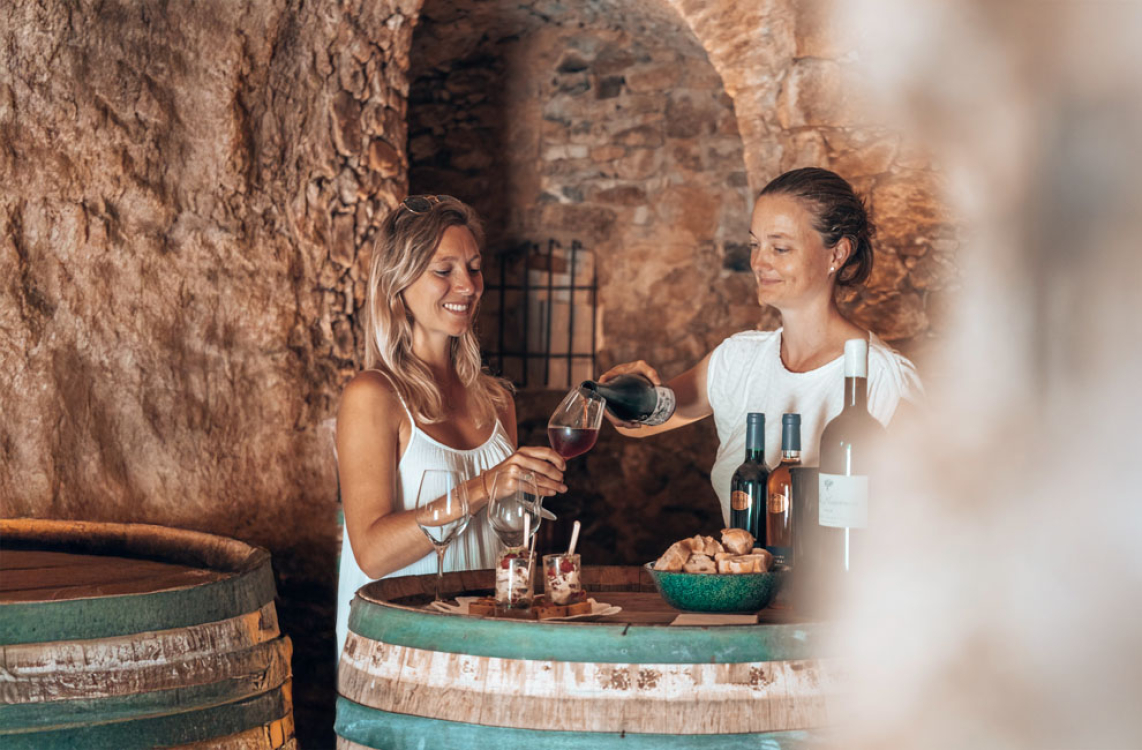 Let yourself be seduced by the perfect pairing of food and wine ©Les droners - Claire & Arthur
The fresh, lemony Vermentinu whites enhance Mediterranean fish and fresh sheep's milk cheeses.
Corsican rosés, which are more structured than their Provençal cousins, accompany Mediterranean starters and grilled vegetables all year round.
The full-bodied, tannic reds from Niellucciu are wonderful with Corsican lamb. The finer wines from Sciaccarellu are a perfect match for charcuterie.
Muscat du Cap Corse, with its aromas of candied fruit and citrus, is the ideal accompaniment to desserts such as fiadone, a chestnut cake. Served chilled as an aperitif, it offers an explosion of flavours that awakens the taste buds.
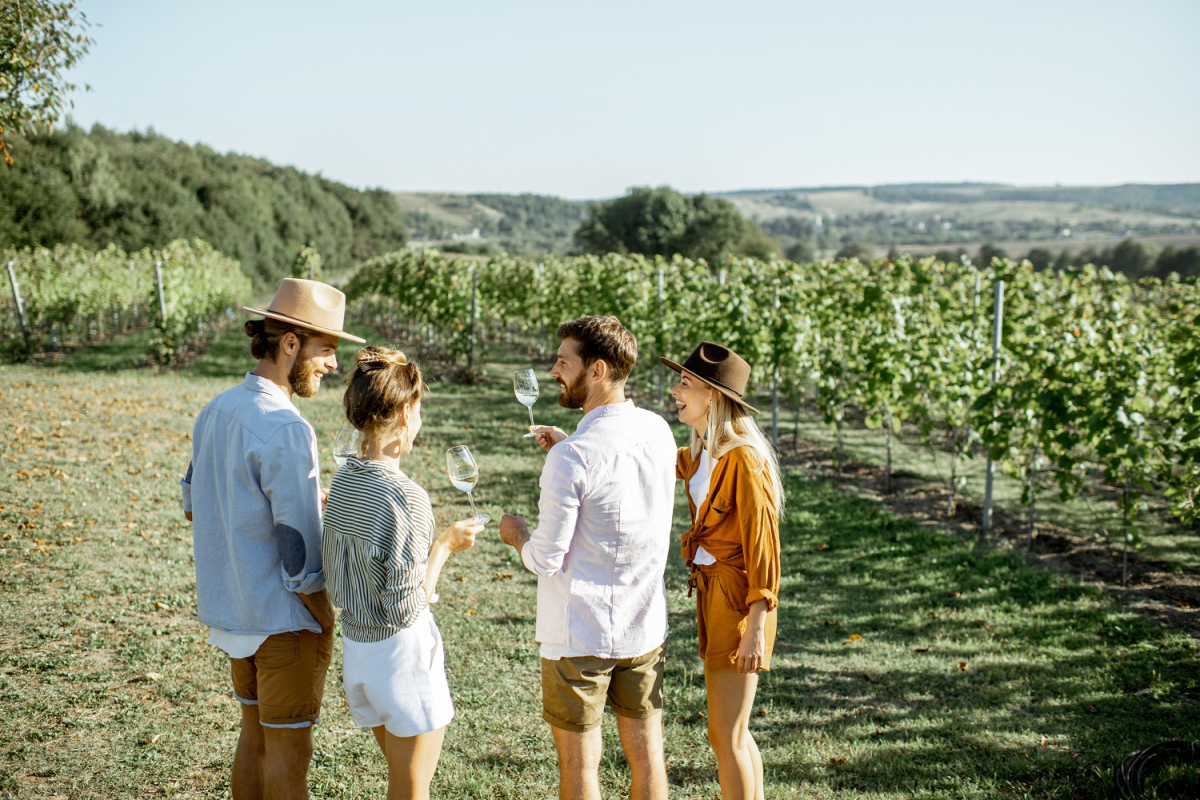
Corsican winegrowers often offer tasting workshops at their estates. These immersive experiences provide an understanding of the deep connection between terroir, grape varieties and island culinary traditions.
Authenticity remains at the heart of Corsican winemakers' concerns. By preserving their ancestral grape varieties, tasting also becomes a cultural journey. A glass of Corsican wine is a little bit of maquis, sunshine and island character. A Salute!
Locate