Rechercher...
AULLENE
Presentation
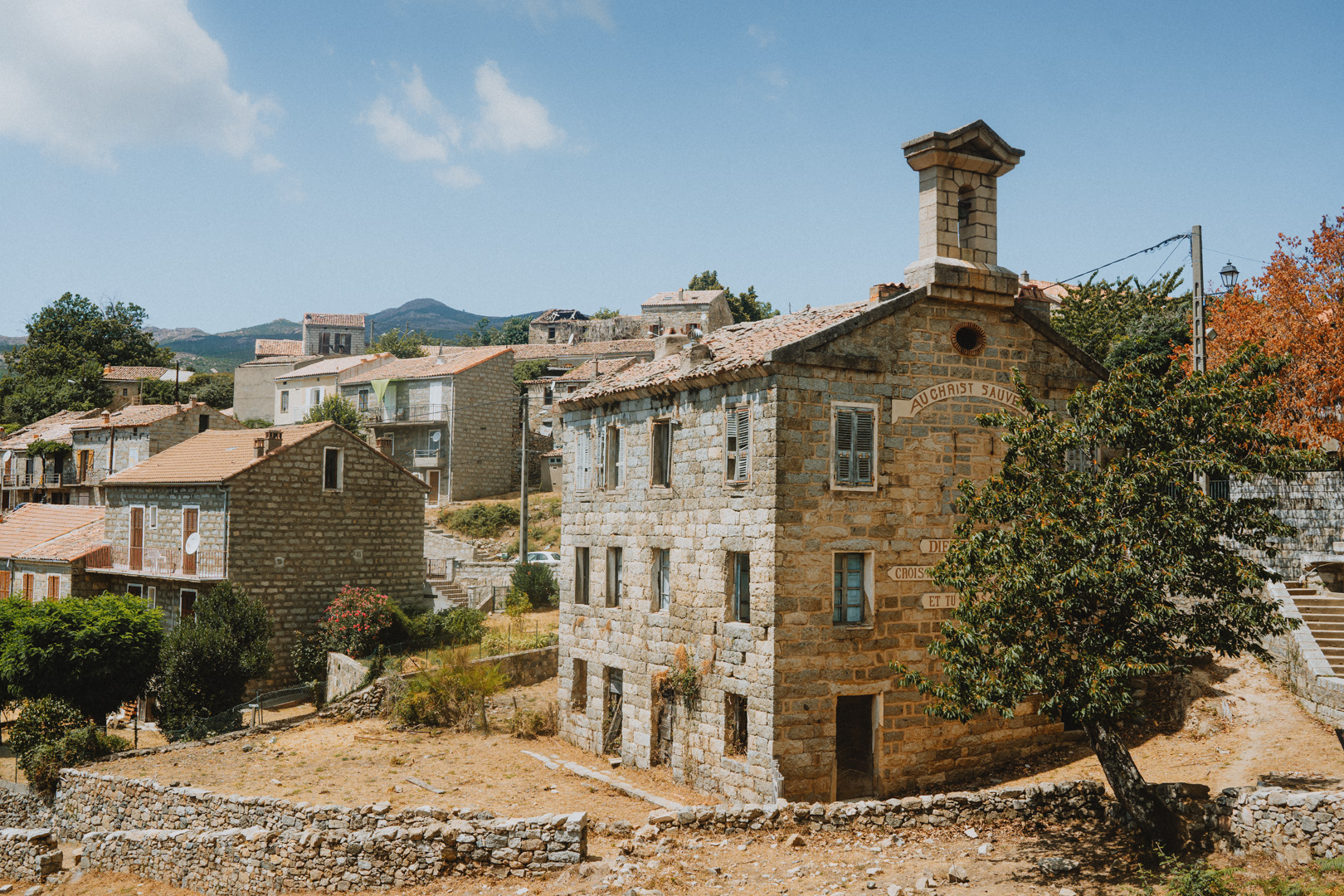
Perched at an altitude of 850 metres, the village of Aullène wraps around two 'poghji' (promontories) dominated by the Punta d'Ariola, a 1,449-metre peak. The ridge lines, whose main peak, Punta di Sistaja, rises to 1724 metres, form the natural boundaries of the village to the east, north and west, while the Col de la Tana limits the territory to the south-south-west. The Chiuvone, which rises on the Cuscionu plateau, marks the north-north-east boundary of the municipality and runs alongside the village before continuing south-south-west towards Valinco.
The village of Aullène, in the heart of the Alta-Rocca region, has a long-standing pastoral tradition, with the villages of Monaccia d'Aullène and Ghjanuciu at the foot of the Cagna mountain. It's not unusual to find the same families in all three communes.
In the centre of the village, don't miss the Santu Nicolau parish church. This place of worship is home to a real marvel: a carved wooden pulpit dating from the 18th century, listed as a Historic Monument. This delicately crafted masterpiece of carpentry bears witness to the cultural and religious importance of Aullène over the centuries.
One of the highlights of village life is the annual festival in honour of Santu Antiochu on the first Sunday in August. On this occasion, a solemn procession departs from the village church for the rural chapel of Santu Antiochu, located a few kilometres from Aullène. This chapel, a place of meditation, is the setting for a unique celebration marking the Feast of the Transfiguration. The village festival that accompanies this procession is also an opportunity to revive an ancient tradition: the cattle fair, which was once one of the most important in Corsica. In the past, this fair made Aullène an essential meeting place for livestock farmers and traders. Today, even though the fair is no longer on the same scale, it is still a very convivial event, where the community celebrates its rural past while sharing a festive moment based around local produce.
For history buffs, Castellare is a must-see. Perched on a small summit, you can discover the remains of an ancient stronghold, probably built in the 11th century. The site offers uninterrupted views of the surrounding area and is a reminder of the time when this fortress defended the region. A walk to Castellare takes you back to Corsica's medieval past, while enjoying the peace and beauty of the mountainous landscape. Below, on a dome planted with chestnut trees around which part of the village, "Campanaju", wraps, the stronghold of Sinucello Della Rocca is thought to have been built in the 13th century, the man who succeeded for a very short time in unifying almost the entire island.
Child benefits
No
Locate