Rechercher...
ÉGLISE SAINTE JULIE
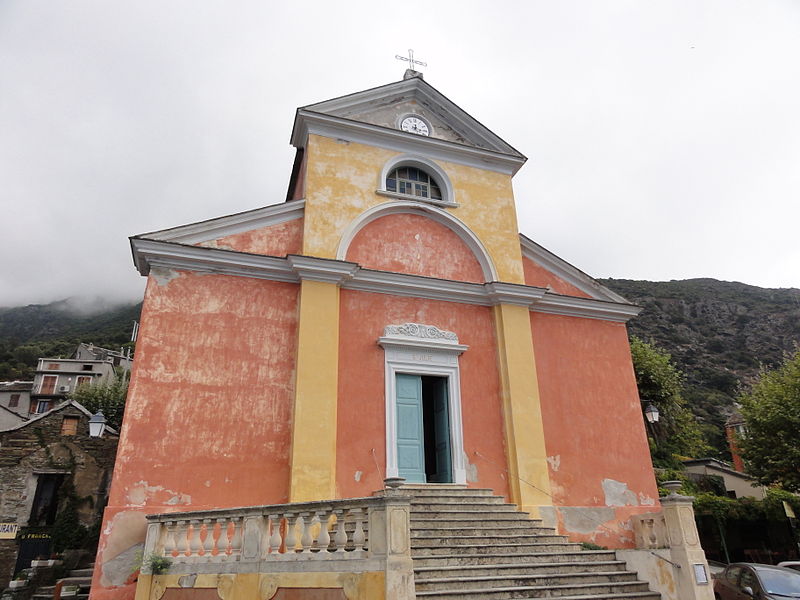
20217 Nonza
Presentation
Church of Sainte-Julie – Chjesa Santa Ghjulia
Julie in Nonza.
Who was Julie?
A deep mystery surrounds the life of Julie in Nonza, a virgin and martyr whose feast day is celebrated every 22 May.
The Hieronymian Martyrology, compiled in the mid-5th century, records that her cult is still practised in Corsica.
Clearly, both historical tradition and scholars agree that she was born somewhere in Africa. It is highly likely that her martyrdom, which took place during the reign of Diocletian in 303, occurred in Nonza.
Nor can it be ruled out that the saint’s relics passed through Corsica before reaching the city of Brescia, where they are still preserved and venerated.
Whatever the conflicting accounts, and whatever the mix of proven history and legend, Anton Pietro Filippini, archdeacon of the diocese of Mariana, explains the foundation of the church at Nonza in his *Istoria di Corsica* (1594): ‘When the city of Carthage was captured and laid waste, the maiden Julia was taken prisoner along with others. When the spoils were divided, she fell to a certain Eusebio, a pagan from Palestine; she served him with the utmost zeal, and spent the rest of her time in fasting and prayer. Eusebio was well aware of her pious practices; he had also recognised that she was a Christian; nevertheless, as he found her to be a devoted servant, he turned a blind eye to everything and felt great affection for her. It so happened that Eusebio subsequently set sail for France on a ship laden with goods, taking Julie with him. The wind drove them to the island of Corsica, to Nonza. […] A feast was then prepared, at which Eusebio was deliberately plied with drink until he remained fast asleep for a long time. They took advantage of his sleep to abduct Julie; the pagans sought to force her to sacrifice to their idols, but she would never consent to it. They bruised her cheeks, hung her up by her hair and beat her with rods. Finally, as nothing could shake her steadfastness and courage, and as she continued to profess her faith in and call upon Jesus Christ crucified, the pagans crucified her themselves, and she soon gave up her soul to her Creator. ’ The account reported by Filippini is chilling. Times are hard. People were being plundered, disembowelled, burnt, and other such ‘delights’. Oral tradition adds that Julie’s executioners cut off her breasts and hurled them against the rocks below the village of Nonza. Two springs gushed forth from the rock.
A pioneer in the study of Corsica’s medieval history, Geneviève Moracchini-Mazel stated with certainty in her book *Corsica Sacra* (A Stamperia, 2005) that archaeological excavations there would reveal an early Christian sanctuary.
In Nonza, let’s visit the church and quench our thirst at the fountain. There, everything evokes the memory of Julie. There, one can almost touch the invisible and reveal its indispensable presence in our world.
In 2019, a Tuscan delegation came to Speluncatu to inaugurate the first Corsican stage of the project ‘Il Cammino di Santa Giulia – The Way of Saint Julie’, a cultural route linking 22 towns in Tuscany. The delegation was then welcomed in Nonza to discuss the next phase of the project with Patrimonio and Bastia.
©Patrick Saliceti,
Director of the Cap-Corse Inter-municipal Tourist Office (Capicorsu)
Child benefits
No
Locate