Rechercher...
GHISONI
20227 Ghisoni
04 95 57 61 28
Presentation
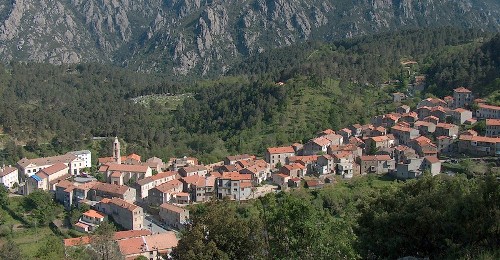
Dating back to the early 14th century, the village is built at the foot of Christe Eleison and Kyrie Eleison, two remarkable peaks whose names recall an episode in the struggle against the "Giovanneli" sacrificed by Rome.
In the Middle Ages, Ghisoni was the scene of one of those historic events that are steeped in both history and legend - the Ghjuvannali or Giovannali. The Ghjuvannali or Giovannali were a brotherhood of dissident Franciscans who originated in Carbini in the Alta Rocca in the mid-14th century and spread to several parts of Corsica.
Their social and religious doctrine was based on poverty and self-giving, the community of goods and the refusal of the sacrament of marriage. They advocated humility, simplicity, poverty and non-violence. Their hostility to the church and feudal hierarchy earned them enemies with both the local lords and the Bishop of Aleria, who excommunicated them in 1352.
The Ghjuvannali appealed to the Archbishop of Pisa and had the excommunication lifted, and their spirituality and religious and social sense continued to spread throughout most of Corsica.
This is probably why, in 1354, the Bishop of Aleria went to Pope Innocent VI and accused the Ghjuvannali of heresy, obtaining a papal excommunication. This papal commissioner, supported by the local lords, organised a holy military crusade in the Carbini region and in the Eastern Plain. Between 1363 and 1364, in the name of the Church, many Ghjuvannali, including women and children, were massacred in Carbini, Ghisoni and other villages. Some, rather than renounce their faith, died with weapons in their hands. The last Ghjuvannali who took refuge in Ghisoni were burnt there, and popular memory has it that as the heretics went up to the stake, the parish priest and the locals accompanied them, singing the liturgical prayers, "Lord, have mercy, Christ, have mercy", and the two mountains overlooking Ghisoni joined in the prayers, repeating "Kyrie Eleison... Christe Eleison...".
. Ghisoni is the ideal starting point for hikes and walks. The forests of Marmanu (D69) and Sorba offer trails accessible to all on foot or mountain bike. Several loops leave from the village, offering pleasant routes that combine heritage and nature discovery. In winter, the ski resort attracts many enthusiasts.
SIGHTSEEING
- The parish church: a former Franciscan convent church dating from the 17th century.
- The chapel of Santa Croce: built in the 15th century and adjoining the former church of Santa Maria, listed as a historic monument in 1989.
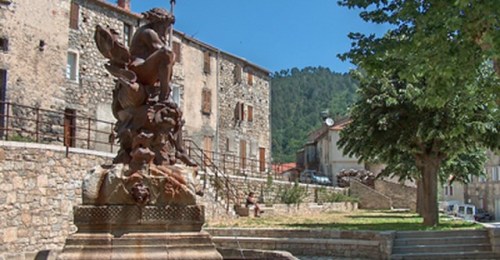
The Neptune fountain in the centre of the village, with its cast-iron statue by Gabriel-Vital Dubray (1856), cast by Val d'Osne in Haute Marne.
Genoese bridges :
- The Mela bridge: located 5 km from Ghisoni.
- Ponte Vecchju: built around 1650, located at the entrance to the village.
- The Catani Bridge: built around 1840.
- The old Finosa mine opened in 1912 and closed after the Second World War, producing lead, silver, manganese and iron.
- The Inzecca gorge: on the outskirts of the village, it offers an imposing, Dantesque landscape.
Ghisoni is an integral part of the Parc Naturel Régional de Corse (Corsican Regional Nature Park) and is the ideal starting point for hikes and walks. The forests of Marmanu (D69) and Sorba offer trails accessible to all on foot or mountain bike. Several loops leave from the village, offering pleasant routes that combine heritage and nature discovery. In winter, the ski resort attracts many enthusiasts.
Visit the commune's website here >> http://www.ghisoni.fr/
Child benefits
No
Locate