Rechercher...

LA BAIE DE CROVANI

L'Argentella, 20214 Calenzana
Presentation
If you take the D81B and carry on towards Galeria/Porto, you will reach the Argentella site, which is about 16 km further on. The journey takes about half an hour by car.
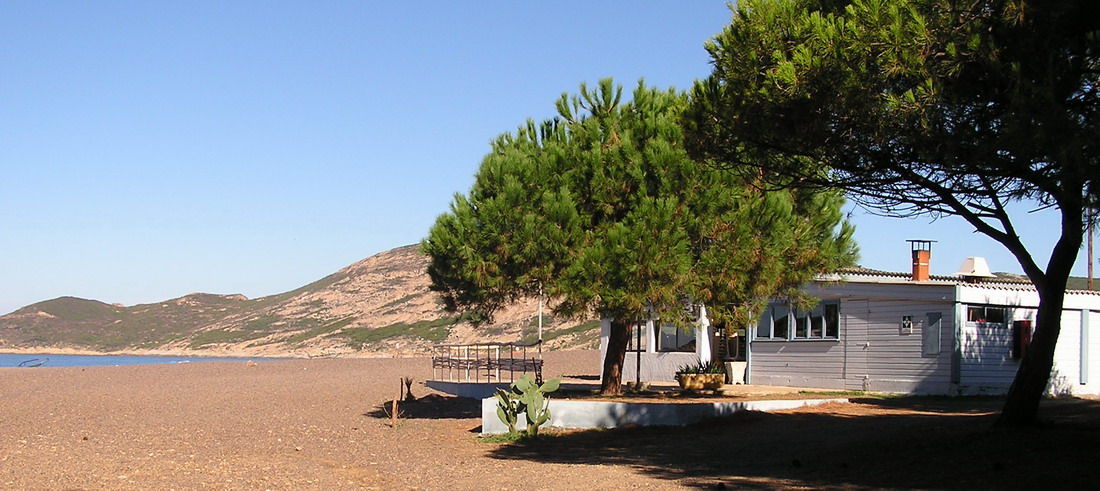
Crovani Bay, more commonly known as Argentella Beach…
Once you arrive, you’ll see a beach of tiny pebbles down below on your right. Look out for the La Morsetta campsite or the Marina d’Argentella hotel; both have direct access to the beach. It’s an ideal spot for families as well as for a romantic getaway. Although quite busy in summer, the area retains its wild and intimate character.
The Argent Mines
This former open-cast and underground mining site takes its name from the silver-bearing lead (argentu in Corsican) that was extracted there. Copper (chalcopyrite) was also produced here; on the site, there was a mineral processing plant that operated from 1856 to 1930. You can walk along the path that branches off to the right of the road to see the ruins of the plant and admire the view over Crovani Bay; however, it is not advisable to go as far as the mine entrance.
A bit of history
Although a document dating from 1572 already attests to mining activity on the site, it was not until the second half of the 19th century that plans for development were realised: a concession covering an area of 2,520 hectares was granted on 9 January 1856 in the name of the Moullet Company. The concession was extended on 14 April 1874. However, the most extensive work took place from 1872 onwards, following the transfer of the concession to C. Collas. A dam was built, new mining sites were opened up (the Valle Calde copper deposit), and buildings and Port Julia (Crovani Bay) were constructed.
Yields do not appear to have been very good, and from 1876 onwards, the plant operated intermittently. The mine was bought in 1886 by English investors who founded Argentella Mining Limited: more than 200 people worked there before it was abandoned once again in 1888.
In 1891, the Argentella Mining Company breathed new life into the site, but work ceased when the site came under the ownership of Arthur C. Southwell, the British vice-consul in Bastia. He sold off the factory’s equipment in 1898. Attempts were made to mine the site in the 1910s and again in the 1920s. Work was carried out between 1928 and 1930 by the Société d’exploitation Minière de la Corse.
Locate